CASE STUDY

Gas Transmission Emissions Monitoring: Gas Terminal

Installation of MethaneTrack for National Gas at Bacton

Overview

National Gas partnered with NevadaNano to evaluate continuous methane emissions monitoring at a gas terminal in the United Kingdom. The project aimed to improve emissions visibility across a large operational transmission facility while supporting ongoing efforts to enhance leak detection, localization, and operational response capabilities.

Using MethaneTrack™, the deployment focused on continuously detecting and quantifying methane emissions across multiple operational areas of the site, providing engineers with real-time emissions data to support verification activities and emissions awareness across transmission infrastructure.

About the Site

The deployment took place at a major coastal gas transmission and processing facility in Norfolk, England, one of the United Kingdom’s largest natural gas handling sites. The terminal receives natural gas from offshore North Sea fields before processing and transmitting it into the UK National Transmission System (NTS).

The site includes extensive transmission infrastructure spread across a large operational footprint, including valves, piping systems, venting locations, compressors, seals, and other potential methane emission sources. Because of the scale and operational complexity of the facility, continuous monitoring required a deployment architecture capable of supporting broad coverage, reliable communications, and high-resolution emissions visibility across multiple leak-prone areas.

Case_Study_Bacton_4

Customer

Gas Transmission Operator

Region

Bacton, United Kingdom

Installation Type

Gas Transmission Terminal

Product

MethaneTrack™

Asset Monitoring

Transmission Piping, Compressors, Valves, Venting Infrastructure

Gas Type

Methane

Challenges

Monitoring emissions across a large-scale gas transmission terminal presents several unique operational challenges:

• Detecting methane emissions continuously across a complex and geographically distributed industrial site
• Identifying intermittent, operational, and fugitive emissions in real time
• Localizing emissions accurately enough to support field verification activities
• Maintaining reliable monitoring performance across distributed transmission infrastructure
• Deploying a scalable monitoring system with minimal disruption to ongoing site operations

Traditional periodic inspection methods can struggle to capture short-duration or intermittent emissions events, particularly across large facilities where emissions sources may vary significantly over time. Operators required continuous, high-fidelity emissions visibility capable of supporting both operational awareness and ongoing emissions monitoring efforts.

NevadaNano's Role

NevadaNano deployed its MethaneTrack™ continuous monitoring platform across key operational areas of the gas terminal to provide real-time methane emissions detection, localization, and quantification.

The deployment included:
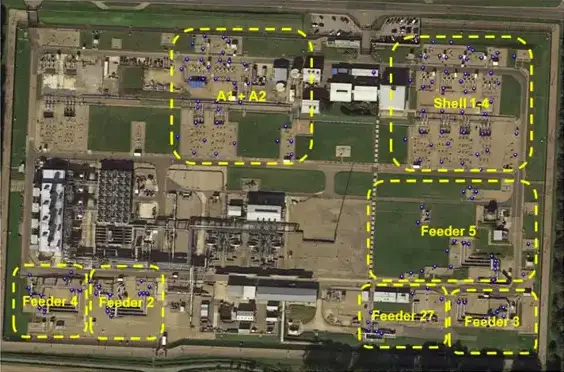
• 155 wireless monitoring endpoints installed across seven primary leak monitoring areas
• 2 LoRa gateways supporting wireless communications and cloud connectivity
• 2 anemometers supporting wind-aware emissions localization capabilities
• MethaneTrack™ software visualization and Leak Source Isolation™ (LSI™) event tracking tools

Battery-powered wireless endpoints were deployed throughout the site near critical infrastructure and potential leak sources, enabling rapid installation without extensive wiring or disruption to ongoing operations.

Process and Implementation

Bacton Site Deployment of MethaneTrack

1. Large-Scale Gas Transmission Emissions Monitoring

MethaneTrack™ endpoints were deployed across seven primary leak monitoring areas throughout the gas terminal. Installation locations focused on infrastructure associated with potential methane emissions sources, including valves, piping systems, venting locations, and other operational equipment distributed across the facility.

The deployment utilized a wireless LoRa-based communications architecture with centralized gateways and anemometers to support continuous connectivity and wind-aware emissions monitoring across the site. Installation of all 155 endpoints was completed in approximately three days.
Case_Study_Bacton_2_Leak_Alert.webp

2. Continuous Monitoring and Leak Source Isolation™ (LSI™) Analysis

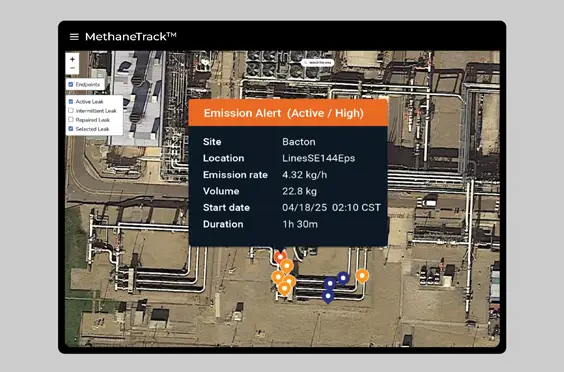
Once operational, the system continuously monitored methane emissions in real time, generating Leak Source Isolation™ (LSI™) events as emissions were detected throughout the facility. Continuous monitoring enabled operators to track emissions timing, duration, estimated leak rates, and emissions trends across varying operational conditions.

Throughout the deployment, the system captured a range of emissions behaviors, including persistent fugitive emissions, operational venting events, and intermittent releases associated with site activity.

Screenshot of LSI at Bacton. showing the MethaneTracks and leaks

3. Field Verification and Operational Evaluation

Site engineers used LSI™ event data to support targeted field verification activities and investigate detected emissions events. Calculated leak locations generated by MethaneTrack™ were used to help identify potential fugitive emissions sources and operational release conditions across the monitored areas.

The deployment also provided continuous visibility into emissions behavior across the site, supporting ongoing evaluation of continuous monitoring technologies for transmission infrastructure applications and future monitoring initiatives.

Results and Impact

During the six-month deployment period, MethaneTrack™ detected 161 methane leak events across the monitored portions of the gas terminal, ranging from less than 1 scfh (0.03 kg/hr) up to 9.1k scfh (231 kg/hr). Total monitored emissions during the deployment period were approximately 9,990 kg.

The system continuously identified a wide range of emissions behaviors, including persistent fugitive leaks, operational venting, recompression-related releases, and intermittent emissions events that may otherwise have been difficult to capture through periodic inspection methods alone.

Field verification activities performed by site engineers demonstrated strong alignment between calculated leak locations and observed emissions sources, with most verified events identified within approximately five meters of the source location. The deployment also demonstrated the ability to consistently detect persistent emissions greater than 1.0 L/min and, in some cases, leaks as small as 0.2 L/min.

The project also demonstrated the scalability of continuous monitoring across large and operationally complex transmission infrastructure. Despite the size of the facility and number of deployed endpoints, the system was installed rapidly, required minimal ongoing maintenance, and provided continuous real-time emissions visibility across the monitored areas.

In addition to supporting methane emissions monitoring efforts, the deployment provided operational insight into how continuous monitoring technologies may support future monitoring initiatives across evolving transmission infrastructure applications.

Related Case Studies

Landfill Emissions Monitoring: Gas Collection Optimization
Offshore Emissions Monitoring: Persian Gulf Platform
Compressor Station Emissions Monitoring: Permian Basin
Scroll to Top